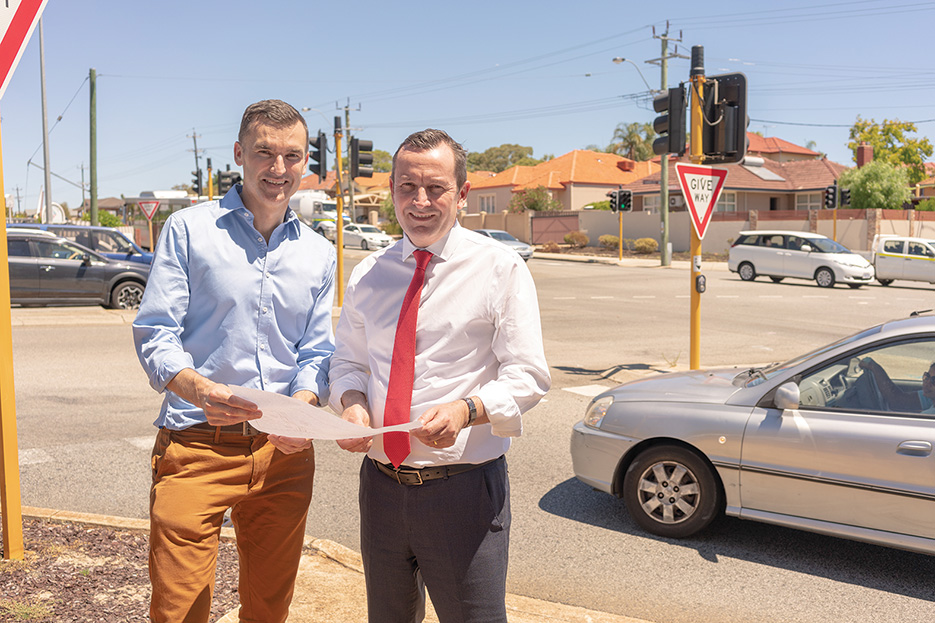
• Labor MP John Carey and premier Mark McGowan at the notorious North Perth intersection.
ONE of the worst intersections to navigate in Perth will get a $2.5 million upgrade from the state government.
The notorious North Perth intersection at Wanneroo Road, Green Street and Walcott Street will be made safer using funds from the government’s Road Trauma Trust Account.
A new traffic signal mast-arm on Wiluna Street will make it easier to see the lights, and a dedicated green arrow will make it safer when doing right-turns off Charles Street.
Improve safety
Perth MP John Carey says “it is well known as a difficult spot, so these measures are about improving road safety.”
He says he also wants to improve safety at the intersection of Scarborough Beach Road, Main Street and Green Street.
“That is the hot issue in the neighbourhood,” he says
Mr Carey made a $3 million election commitment to upgrade the intersection, but it straddles Vincent and Stirling councils, and they have to agree with Main Roads on the best design.
Mr Carey says a solution isn’t too far down the road with detailed plans being drawn up.
Alive & kicking JUST read you section on ‘Seniors’ and by the time I got through all the patronising ‘aids’ I almost needed help to assuage my blood pressure.
The aids included ‘Balancing your Meds’, ‘Buckle up’, how to ‘help someone living with Dementia’ and many many more.
No doubt the Voice benefits financially from all this condescension, but this is troubling in the extreme, as the assumption is that anyone over 65 is ready for a ‘home’, needs help to walk, or requires a stairlift or aged care.
It would be rather nice to feature the many people over 65, or indeed over 70, who are physically and mentally active in 2019 without being patronising.
My friends and I (who are of a certain decade of birth) walk a lot every day, swim in our wonderful ocean, have quarter-acre gardens which are self managed and provide joy every day, play tennis, golf and bridge, have a great social life, are members of WASO, look after grandchildren, and many are still gainfully employed in areas like architecture, university lecturing and computing.
We are also important members of our local communities (treasurers and secretaries), and last but not least are avid volunteers across the spectrum.
So…how about a few positive profiles of the ‘seniors’ of our community! Mattie Turnbull Address supplied Ed says: We have run lots of positive stories about amazing seniors who are very active in the community, but unfortunately there are elderly people who do suffer from poor health. These people are just as brave and amazing, and we try to cover all the bases over the course of the year.
Who’s the dud? AFTER reading the article “Vincent council starts street works” in last week’s Voice, I came to the conclusion that perhaps this week’s headline should read – City of Vincent dud. The planned upgrades include planting 38 new trees (great idea), of which 20 will be planted on the side of the road, thereby eliminating 20 car parking bays (bad idea). If anyone is familiar with the area in question, it’s obvious that car bays along that strip are already in short supply due to the cafes, restaurants, offices, wellness centres and many other businesses there. The other thing I noticed in the “before and after” pictures is that where there is currently a continuous white line separating the two lanes of traffic, the upgrade will include a “pedestrian refuge median strip”, which I assume would be about 1m wide. This raises some very obvious safety concerns, but I guess cars and cyclists smashing into opening car doors is less of an issue than having a refuge to stop in the middle of the road. The thing that I found amusing, in a moronic kind of way, was that “The goal is to improve connectivity between the Leederville cafe strip and the Mount Hawthorn centre, as it’s a long Nullarborous scorcher of a walk”. Really? I had to check it wasn’t April 1. Worse still, who came up with this policy for our council to implement? The idea that these technocratic (bad) policies are being implemented for the sake of spending public funds is sheer arrogance to say the least. Gene Lorenzon Address supplied Ed says: The changes will result in the loss of five car bays, and the addition of two motorbike bays and 12 bike racks.
• Chase Webber with his beef shin rendang. Photo instagram.com/thestandardperth
LAUGHTER and conversation burst through the politically-charged lyrics of Childish Gambino’s This Is America.
Waiters weave through customers darting from the crowded bar to the bustling beer garden.
The Standard in Northbridge is one of Perth’s most feted restaurants and I’m happy to report the cuisine is as electric as the pumping atmosphere.
The rocking soundtrack blaring through the venue’s speakers had us bopping in our seats as we sang head chef Chase Webber’s praises.
Of all the dishes on the menu, the beef shin rendang ($38) is Webber’s magnum opus.
The locally-sourced beef shin is slow cooked to perfection with each chunk of meat as tender the next. The moist beef is swimming in a rich rendang glaze, with roasted peanuts and toasted coconut adding texture and crunch.
A bit like a culinary Excalibur, a half bone brimming with creamy, fatty marrow impales the rendang.
Some may squirm at the thought of eating bone marrow, but if you’re a carnivore I recommend treating your taste buds to the unique flavours.
A bowl of rice would have been great to soak up the rendang, but maybe the chef thinks rice is too pedestrian for such a complex dish?
The caramelised pork satay dip ($9) is not what you’d expect and is more of a chunky, spreadable paste.
Small pork nubs are coated in a knockout sauce that includes coriander, fish essence and peanuts. When spread over the accompanying rice crackers it’s divine.
The Standard’s Masala
deep-fried chicken nuggets ($15) are coated in a dark butter curry sauce and chilli salt.
It’s crunchy, juicy and finger-licking good. And if you find the chilli a bit too lively you can refresh your palate with the yoghurt dipping sauce.
Perth’s booming restaurant scene has a lot of groundbreaking chefs, but Chase Weber at The Standard is one of the most exciting around.
By MATTHEW EELES
The Standard 28 Roe Street, Northbridge Phone 9228 1331 thestandardperth.com.au
TRESPASSING is an intriguing blend of experimental theatre and video/sound art.
Watch in awe as four women dive into a world of visual projections and toy with each other’s emotions.
Created by Fremantle director Bello Benischauer and partner Elisabeth Eitelberger, the show confronts trespassing and privacy in an up-close and personal performance that promises to be intense, confronting and “quite loud”.
Trespassing also explores how gender is linked to identity, social interaction, power and oppression based on race, class, culture, religion, sexuality
and consumerism.
“An intimate journey to celebrate the transcultural qualities inherent in contemporary society by breaking boundaries between performer and audience,” Benischauer says.
Part of Fringe World, Trespassing is on at Edith Curtin’s Spectrum Project Space February 11-22. Tickets fringeworld.com.au
• Tower House in Northbridge is a rare Perth example of a purpose-built boarding house. Photo by Heritage Perth
HISTORY buff RICHARD OFFEN is the author of Lost Perth, and the former executive director of Heritage Perth. In this week’s HERITAGE CORNER he tells us about the birth of boarding and lodging houses in Perth, including how widows took in lodgers during the Great Depression to make ends meet.
BOARDING and lodging house accommodation was an important feature of the early development of the colonies.
Single men or those intending to bring their families out to the new areas often used boarding houses in preference to other forms of accommodation such as inns and public houses as they were viewed as a respectable form of accommodation, which included the provision of meals and cleaning.
In the early days of the Swan River Colony, there seemed to be a distinct lack of such accommodation, as a letter to the editor of The Perth Gazette in 1837 shows:
“Sir, The want of a respectable boarding-house in Perth for gentlemen occasionally visiting headquarters is so much felt by settlers residing at a distance, that I am surprised it has never occurred to anyone to try an experiment, which I have no doubt would be attended with complete success. The company at an inn is often unsuitable for those that prefer quietness and regularity. Your obedient Servant, A Traveller.”
A large number of boarding and lodging houses seem to have been established in Perth during the 1890s, particularly along the length of Hay Street, St Georges Terrace, and Murray and Newcastle Streets as a result of the WA gold rush.
Not unsurprisingly the gold boom economy at this time attracted single men from other parts of Australia and overseas.
Many of them tended to use the boarding houses in Perth as a stopover on their way to or from the goldfields.
Tower House, on the corner of Russell Square and Francis Street in Northbridge, is a rare Perth example of a purpose-built boarding house.
Built in Victorian Italianate style in 1898, it was run for many years by a female proprietor – an occupation which was considered acceptable for single or widowed women in the nineteenth and early twentieth centuries.
The building operated as a boarding house until it was acquired by the Hellenic community in the 1950s, and since then it has been used as a rectory, Greek school, restaurant and, after renovation in 2006, offices.
A lodging house, in contrast to boarding houses, was considered to be a cheap form of accommodation for the working class, transients and the poor. They were also seen as a shorter-term accommodation option.
One report described lodging houses as, ”…poor quality, over-crowded and posing substantial health risks.”
Lodging houses were particularly popular during periods of economic hardship, such as during a world war or the Great Depression. During such periods, widows would take in lodgers to provide income for their family.
The Depression years of the 1920s and 1930s saw demand increase for cheap accommodation in the inner city areas as people tried to find work.
Perth’s boarding and lodging houses started to go out of fashion after World War II, when reasonable hotel accommodation became more affordable and other types of subsidised housing became available for those in need.
THIS is an extract from the VINCENT WRITING CENTRE’S first anthology of short stories and poetry. To get the full story and a stash of others, contact PETER JEFFERY on peter.jeffery@iinet.net.au or call 0481 462 612
by ANGELA JONES
THE land does not have a name, we looked for an indication at both ends but there is nothing.
So we call it Art Lane, or as my little grandson says, “Heart Lane” which is rather apt.
We really love walking down this lane, my grandsons and I. Sometimes there are two of us, sometimes three, but most often all of us – me, two brothers and their little cousin.
We make and remake stories about what we see, adding as we go, or inventing new stories if we forget the ones previously made up. We have our favourites, or least favourites, depending on the mood we are in.
We visit the lane usually Tuesday afternoon, after Oscar and Noah have their piano lesson, while their little cousin, Oliver, sits and watches, tapping his foot in time – the human metronome the piano teacher calls him.
We walk to Beaufort Street for a treat but it is the lane that is the real reward.
Past Hutt and Grosvenor Street corner, just before the ‘tortured’ gum trees, we turn right and stop in front of the first mural: the pretty girl with the wild hairdo. This is our favourite.
We love the clever way the artist has blended nature with art.
The girl looks intelligent and alert with her bright eyes framed by big glasses.
It is as if she is speaking to us.
“Look at me, my lemon tree hair, my lemon earring, lemon leaves for eyebrows, yet I am as real as you are.”
We give her a name, Leigh Mona, reflecting not just her lemon essence but the fact that she is Art Lane’s main attraction, much like Da Vinci’s Mona Lisa at the Louvre…
WOOLWORTHS doesn’t want to pay for public art at its proposed development on the old Bunnings site on Beaufort Street.
The supermarket giant cites a State Administrative Tribunal ruling that could have far-reaching implications for the “per cent for art” schemes across WA.
Woolies’ application states they shouldn’t have to comply with Stirling’s draft local planning policy that “requires development with an estimated construction cost of between $2 million and $50 million to set aside a minimum of one per cent of the estimated construction cost for the provision of public art”.
Similar policies are common across Perth and have paid for artworks like the Big Blue Head (Beseech) outside the Vincent council building.
But Woolies notes that in 2018 the State Administrative Tribunal ruled that BGC didn’t have to install public art at their $5 million asphalt plant in Hazelmere.
The City of Swan policy required them to put in $50,500 for public art, but BGC appealed and won.
The SAT deemed that the public art wouldn’t have much benefit for the small number of workers at the plant.
Inappropriate
Woolies’ Inglewood development application states that it’s “inappropriate for the city to impose a condition requiring the provision of public art”.
The supermarket giant say the building will be aesthetically pleasing and “the proposal does not cause any adverse visual amenity impact,” and that “there is no connection between the proposed development and the need to provide public art.”
“As there is no visual impact to ameliorate, there is no requirement for public art to be provided”.
by DAVID BELL
Have your say
COMMUNITY consultation is open on Woolworths’ proposed mega-development at the old Bunnings site in Inglewood.
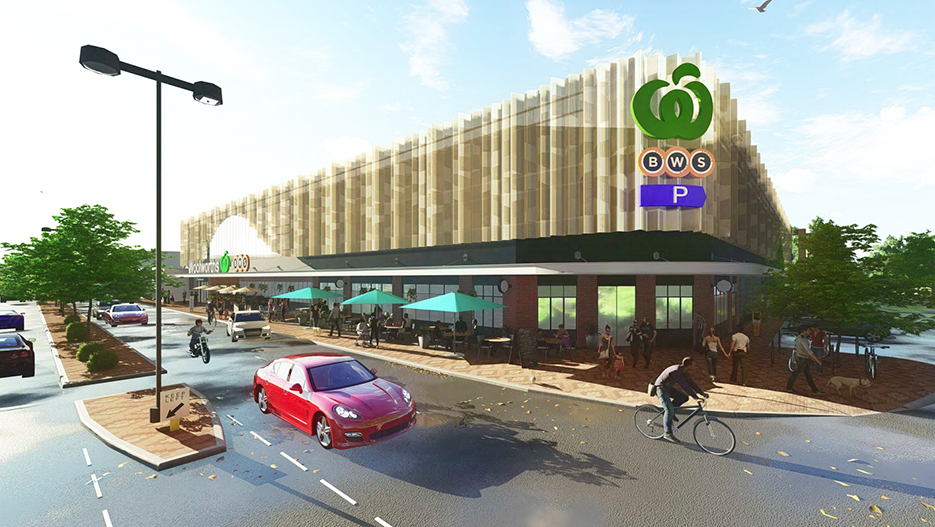
The supermarket giant is proposing a 13.25m high “art deco” style building with basement and ground floor car parks, a supermarket and liquor store on the first floor, offices on the mezzanine, and a cafe on the strip. Comment is open until February 7 at http://www.yoursay.stirling.wa.gov.au (click on the “development applications” section).
The Development Assessment Panel, made up of three state government-appointed experts and two Stirling councillors, will have the final say on Woolies’ application.
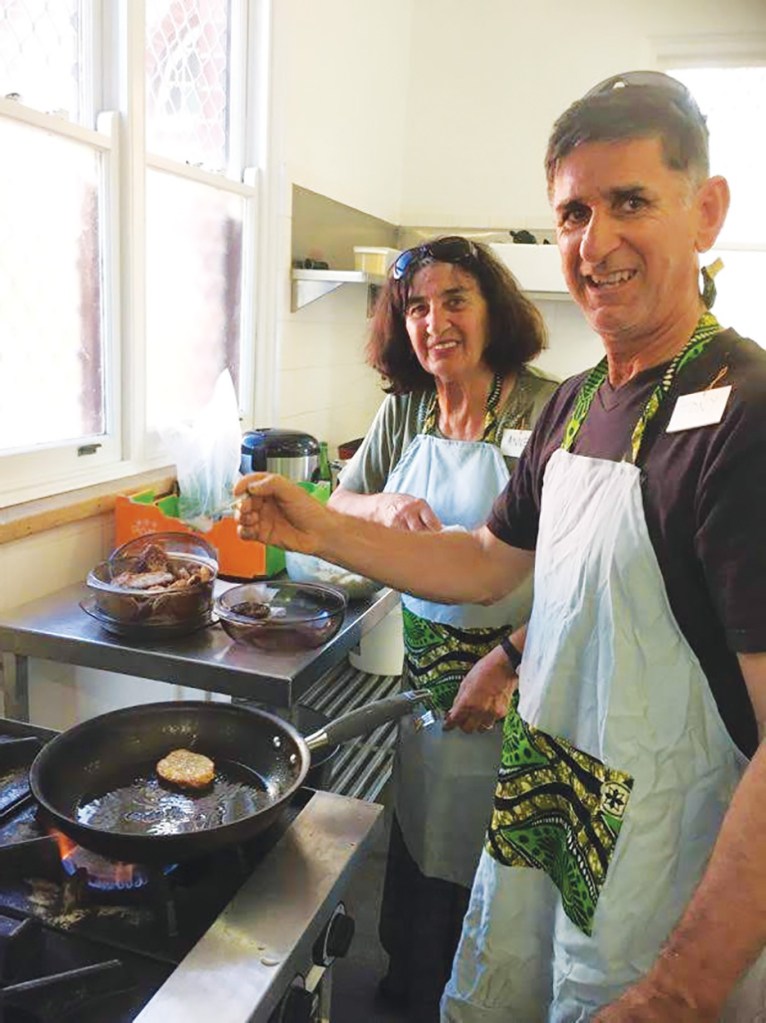
THE Vincent Community Kitchen has been a huge success with double the number of people attending this month’s event.
The Kitchen aims to share healthy affordable meals and build community spirit while diverting food from the dump, where it can contribute to global warming.
Debut dinner
At their debut dinner in November last year they used 100kg of unwanted food to whip-up a huge spread.
Local retailers have been chipping in with unsold stock, and nothing goes to waste with any leftovers used for compost, worm farms, or fed to chickens.
VCK founder Theresa Youngs-Lachmund got the idea from a similar project she saw in London.
At this year’s event on January 13, 30 people helped kicked off the cooking and another 20 came for the meal, with organisers frantically adding tables and place settings as numbers surged.
One guest dropped by because “I was all set to serve up leftover cabbage rolls for my family’s Sunday dinner, when my husband suddenly remembered this event, and we bolted round to the town hall,” and added it turned out to be “such an incredible dinner”.
Ms Youngs-Lachmund said it “was such a fun frenzy in the kitchen all afternoon as volunteers donned their aprons and went to business; everyone helping everyone”.
The community kitchen are now doing events on the second Sunday of every month.
Their next event is February 10, with cooking kicking off at 3pm and meals from 6pm. It’s scheduled for North Perth Town Hall, but keep an eye on http://www.facebook.com/vincentcommunitykitchen/ in case the venue changes.
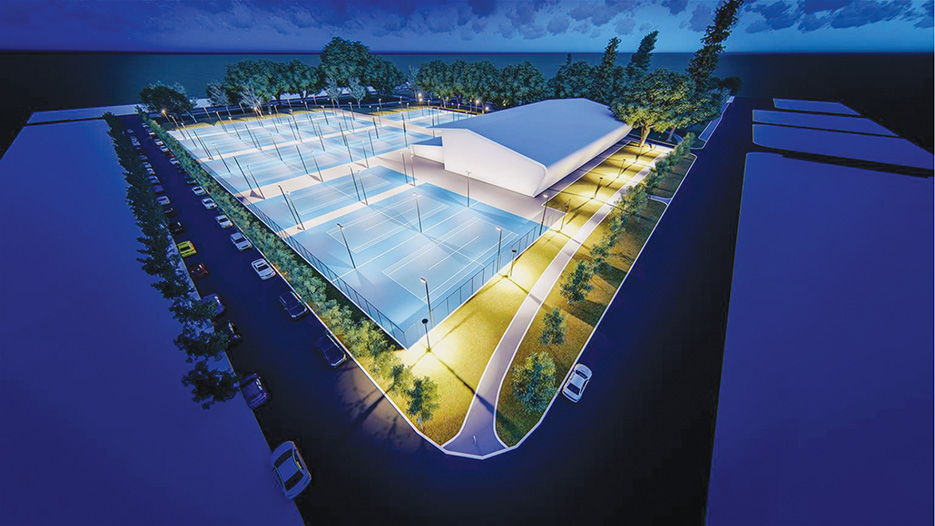
ROBERTSON PARK is no longer in the running to be the new home of WA Tennis after Vincent locals voiced concerns over the loss of trees and open space.
Vincent mayor Emma Cole announced on her mayoral Facebook page on January 19 that the department of local government, sport and culture “has now confirmed that they will not be considering Robertson Park any further, given the concerns raised by the community, and Vincent fully supports this move.”
The existing state tennis centre in Burswood is subsiding and Tennis West is looking for a new home.
They’d prefer to stay put, but fixing the centre would cost between $40 and $50 million, about double the price of building a new one.
The state government and Tennis West shortlisted potential sites including Robertson Park, but the idea was unpopular with locals who formed a community group Friends of Robertson Park and created the website “Save Robertson Park”.
Unpopular
Community consultation was open until January 31, but before it had finished the Robertson Park idea has been sunk.
In her Facebook post, Ms Cole wrote “We share your passion for open space, tree canopy and understand concerns raised about intensification of the site.”
Perth MP John Carey, who walks his dogs at Robertson Park, also thought the centre would have been “too intensive”.
Tennis West CEO Michael Roberts told us “we thought the site was a good site, however we understand that residents were concerned about it. And council made the decision, and so did the [DLGSC] who are leading the business case, that it is probably best that we move on from Robertson Park and not include it”.
Mr Roberts said the other sites being considered will be made public next month after their reports are finalised.
The DSLGC tells us “the existing park would not be impacted” but in any case they add “the department has listened to feedback from the community and the local member.Based on legitimate concerns raised, at this point – and unless there is a complete change in community sentiment – Robertson Park will not be considered further in the business case”.
The new state tennis centre will be used for training and administration and host some international tournaments, but any big ATP and WTP tournaments, or the Hopman Cup, would be held at Perth Arena.